Unpacking "Pillion": This thought-provoking Alexander Skarsgård dom-com is more than meets the eye
This post-film debrief contains spoilers for “Pillion”, which screens from 9 – 15 Feb as part of the 2026 Perth Festival Film Season.
Pillion (Noun) - A seat for a passenger behind a motorcyclist.
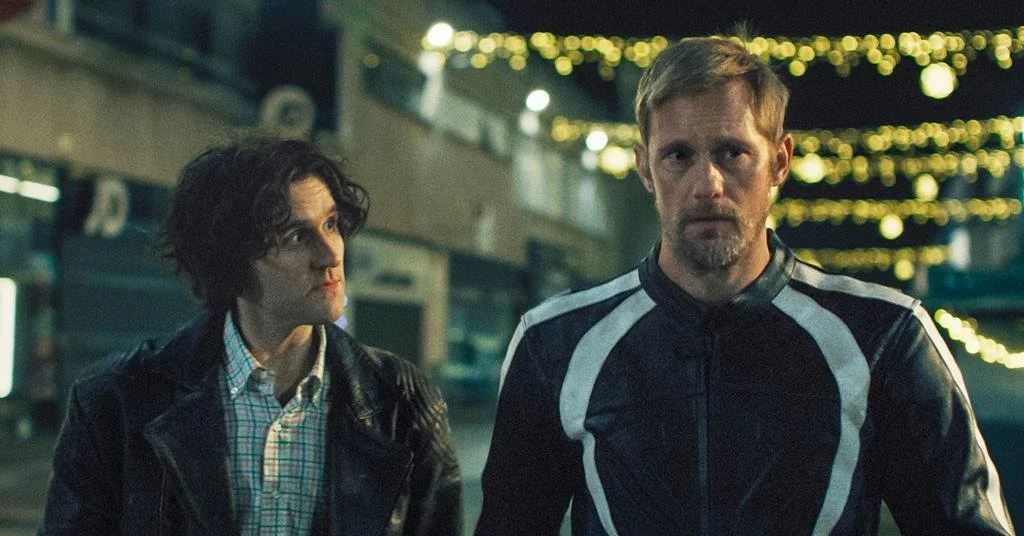
The seat on a back of a motorcycle is fitting for the title of this film. The image of Colin (Harry Melling) with an adoring glow in his eyes, arms wound tightly around Ray’s (Alexander Skarsgård) waist, both bound in leather. It’s fitting because he’s in the passenger seat. He’s forced to follow the lead of this huge, stoic beauty. And Colin is a follower. A young man, still living at home, taking dates organised by his mum, singing in his dad’s barbershop quartet, even when he’s accosted at his job as a parking inspector, he invokes “I’m only following orders” – because this is who he is.
At first, I kept seeing this with the traditional coming-of-age, rom-com expectations: that of a young man who finds himself fascinated with someone new, someone who is the polar opposite of themselves. And here we have Colin, a young, naïve man, incapable of taking charge of his own life, so of course he’d be mesmerised by a huge, handsome, commanding man, the moment he meets him, and gladly accepting of the moulding that comes from Ray’s commands: he shaves his head, dons a full leather bodysuit, even takes a thick metal chain around his neck, bound by a lock, the key of which rests around Ray’s neck.
And as the story progresses, you’d expect it to follow the traditional coming-of-age tropes, that the protagonist would develop a bit of backbone, find some character, and eventually part ways as a better, stronger, more capable person. This is offered at a certain point in the film when Colin, no longer satisfied with being treated as something between a maid and a fleshlight, invokes love and requests equality, a slight nudge to the severely imbalanced scales of their relations. Upon being denied his request of being able to sleep in Ray’s bed instead of on the rug at the foot of his bed, he climbs in, and tries to take some power back.
This is followed by a tantrum, a pushing back on all of Ray’s controlling demands and expectations. After this outburst, we see Colin become something of an equal, if only for one day. We get a glimpse of what a conventional relationship would look like between them, which is both weird and unsettling and incredibly heart-warming, all at the same time. But the glimpse is too much for Ray, who’s blinded by the reality of the equality between them, even if it’s temporary. It’s here that Ray’s stone visage is shattered, and we see a moment of terrified vulnerability, a peek at what lies under his stoic surface, of the fear that might motivate his dominating and controlling persona. And then he disappears, never to be seen again.
Colin mourns the loss, but eventually moves on, starting a dating profile with a neat sign-off to his growth over the course of the film. In his “About Me”, he states he has “an aptitude for devotion” but is unwilling to cut his hair for anyone, a lesson learned the hard way. This points to growth, to a sense that Colin has developed some boundaries, some limits to his submissiveness, but more than anything, it points to his acceptance of his own character as a follower. And this, I find interesting.
There are parts of relationships that no one talks about: the difference in power between partners, how that power can be used to silence complaints, and maintain control in the status quo. The BDSM, dominant-submissive dynamic analogises this incredibly well, and sheds light on certain dynamics that are present in all kinds of romantic relationships. The way people have to acquiesce to behaviour they might not deserve for the sake of hanging on to someone they care deeply for.
Every time Colin accepts Ray’s treatment, it’s with a mesmerised smile, a wide-eyed grin that says, “how did I get so lucky?”, and so every quiet moment of discomfort from being treated as something subhuman is followed by a moment of being chosen, of Colin getting what he wants. And all the undesired is eclipsed by the desired. I found it a reflection of how much I’ve tolerated in relationships in the past. How much sour I’ve swallowed until I received a morsel of something sweet. In this way, I think it’s an incredibly relatable story, told with a lot of compassion for Colin’s yearning for love and acceptance. I was rooting for Colin the whole way: his shocked smile at receiving his own morsel, at being chosen as someone desired by someone beautiful and powerful in all the ways he isn’t.
And so it’s a realistic ending: growth towards something approaching what he wants, whilst still also accepting who he is, what he’s capable of, and his desire for love, even if that takes the form of servitude.
4/5 stars
“Pillion” screens from 9 – 15 Feb as part of the 2026 Perth Festival Film Season.